|
Listening, Discernment, and the Backpack We Carry
Welcome.
This month feels particularly significant as I write to you.
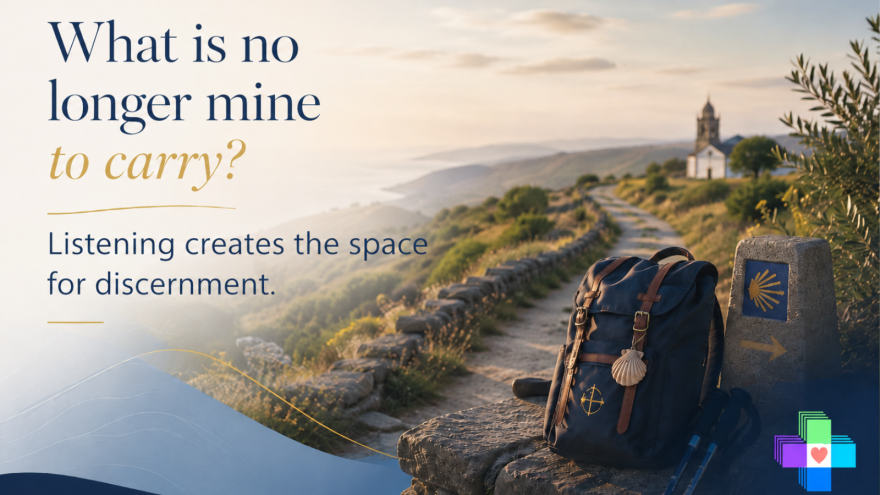
I am preparing to travel to Portugal with my parents, husband, sister, and children to walk part of the Portuguese Camino to Santiago de Compostela.
The practical preparations are underway.
Flights are booked.
Accommodation is organised.
Walking shoes are being tested.
Backpacks are being weighed.
And yet, like many leadership journeys, I am becoming increasingly aware that the real backpack is not only the physical one.
It is the invisible backpack we all carry.
The responsibilities.
The expectations.
The decisions.
The worries.
The hopes.
The stories.
The roles.
The things we have outgrown, but continue to carry anyway.
As I prepare for the Camino, I find myself asking a question I have also been holding with leaders, coaches, pharmacists, and business owners throughout this year:
What is still mine to carry?
And perhaps even more importantly:
What is no longer mine to carry?
Listening Creates the Space for Discernment
Our 2026 theme is Listening.
At the beginning of the year, we explored listening to ourselves.
In Q2, we have been exploring listening in relationships. Listening to colleagues. Listening to family. Listening to teams. Listening across difference. Listening to perspectives that challenge our own.
But increasingly, I am realising that listening itself is not the destination.
Listening creates the space for something deeper.
Discernment.
Discernment helps us distinguish:
What is mine, and what is yours?
What is essential, and what is clutter?
What is fear, and what is wisdom?
What helped me get here, and what will help me get there?
What belongs in the backpack, and what is ready to be left behind?
Without listening, there can be no discernment.
Without discernment, there can be no meaningful change.
The Cost of Carrying Too Much
This month, I have had the privilege of facilitating Implementation Mastery sessions during the Coaching.com Summit.
The conversations have explored many different themes, including burnout, beliefs, thought load, imposter syndrome, difficult conversations, leadership capacity, AI in leadership, and navigating complexity.
You can learn more about the Coaching.com Summit here.
Different speakers.
Different disciplines.
Different language.
Yet a remarkably similar message has emerged.
Many of the challenges leaders face are not caused by a lack of capability.
They are caused by carrying too much for too long.
Too many responsibilities.
Too many assumptions.
Too many expectations.
Too many unresolved conversations.
Too much responsibility for outcomes that ultimately belong to others.
This echoes conversations I have also been having with leaders through the Lead With Coaching Certificate programme.
Some of the most powerful learning in our recent practicum debriefs did not come only from coaching.
It came from observing.
Participants described how transformative it was to sit in the observer seat and simply notice.
Notice the urge to rescue.
Notice the urge to advise.
Notice the tendency to interpret.
Notice how quickly we want to make meaning for someone else.
Notice how often the coachee already has wisdom, insight, and solutions of their own.
The learning was not only:
“I do not have to carry everything myself.”
It was deeper than that.
It became:
To what extent have my own leadership habits unintentionally created the very outcomes I do not want?
Many recognised how easily an over-reliance on expertise can lead to team dependency.
How stepping in too quickly can limit ownership.
How constantly providing answers can reduce critical thinking.
How rescuing can unintentionally weaken capability.
This is the developmental shift we explore within Lead With Coaching.
The move from leading primarily through personal expertise to leading through and with others.
From power over to power with.
From me to we.
You can explore the Lead With Coaching courses here
Family Is Often the Place We Practise
Perhaps nowhere is this more visible than in family life.
One of the greatest gifts my adult children continue to give me is the opportunity to practise what I teach.
When they were young, my role was largely to do things for them.
As they grew, my role increasingly became doing things with them.
Today, my role is increasingly to trust them.
To trust them to think for themselves.
To make decisions for themselves.
To learn from successes and mistakes.
To discover their own capability.
To develop confidence in their own judgement.
This requires growth from them.
But it also requires growth from me.
Letting go of control.
Respecting different paths.
Trusting that they are naturally creative, resourceful, and whole.
Being willing to witness learning rather than prevent every mistake.
Many leadership transitions require exactly the same shift.
Whether you are a pharmacist becoming a pharmacy owner, an owner leading multiple pharmacies, a manager becoming a director, a founder planning succession, or a senior leader building future leaders, the challenge is rarely capability alone.
The deeper challenge is often letting go of the identity that got you here.
The next chapter will not be built using exactly the same tools that built the previous one.
The Hardest Thing in My Backpack
As I prepare for the Camino, I have been reflecting on what I most need to leave behind.
The answer surprised me.
Not workload.
Not responsibility.
Not busyness.
For me, one of the heaviest things has become tolerating misalignment.
Those moments when something does not sit right.
When values and behaviours diverge.
When reality and aspiration no longer match.
When everyone knows something needs to change, yet the conversation keeps being deferred.
Many leaders know this feeling.
The challenge is not always the misalignment itself.
The challenge is carrying it.
Because once we truly see it, we have a choice.
Address it.
Accept it.
Or leave it.
What becomes exhausting is seeing it and carrying it anyway.
What I Hope to Receive
The Camino is often described as a journey of pilgrimage.
Not because of what you achieve, but because of what you become available to receive.
As I prepare to walk, I notice what I hope to make space for.
Perspective.
Rest for the mind.
Movement for the body.
Clarity.
Courage.
Connection.
Forgiveness.
Discernment.
Trust.
Not because these things can be forced.
But because they are more likely to emerge when there is finally enough space to hear them.
Perhaps many of us need more of that.
Not more information.
Not more productivity.
Not more activity.
Just enough space to hear what has been waiting patiently beneath the noise.
A Question Worth Carrying
If I could sit beside a pharmacy owner, coach, executive, healthcare professional, parent, or leader carrying a very heavy backpack right now, I think I would simply say this:
Please put the backpack down for a moment.
Not forever.
Just long enough to notice you are carrying one.
Long enough to recognise the strengths it helped you develop.
Long enough to acknowledge the sacrifices you have made.
Long enough to discern what still belongs in it, and what does not.
You do not have to unpack it alone.
Find someone who can sit beside you without judgement.
Someone who can help you separate what is essential from what is no longer needed.
Someone who can help you listen.
Someone who can help you see.
If this newsletter has highlighted something important you would like space to think through, a Strategic Thinking Session may offer a useful next step.
You can book a Strategic Thinking Session here
Closing Reflection
Somewhere along the Camino, I know there will be moments when the backpack feels heavy.
Not only because of what is inside it, but because carrying it will remind me that every meaningful journey eventually asks the same question:
Is this still mine to carry?
I suspect many leaders are standing before that same question right now.
Not only at work.
In families.
In relationships.
In organisations.
In life.
Listening creates the space for discernment.
Discernment helps us recognise what is essential.
And sometimes, the most courageous leadership act is not picking up more.
It is putting something down.
As you move through June, I invite you to carry one question with you:
What am I carrying that is no longer mine to carry?
And perhaps also:
What becomes possible if I choose to put it down?
Looking Ahead
At the end of June, I will be sharing our Q2 Reflection Newsletter.
Together, we will pause to reflect on the first half of 2026:
What we have been listening to.
What we have learned.
What we have released.
What we have reclaimed.
What wants our attention as we move into Q3.
Until then, may you find moments to pause, listen, discern, and perhaps put down a little of what you have been carrying.
With warmth and appreciation,
Rachel Dungan
The Pharmacist Coach
MPSI | ICF-MCC | ACTC | NBC-HWC | EMCC-SP
Director of Education, Lead With Coaching Institute
Founder, 4Front Pharmacy Solutions
P.S. If this newsletter has highlighted something important you would like space to think through, reply to me at rachel@racheldungan.com and tell me what you are carrying. I will point you towards the most appropriate next step, whether that is a Strategic Thinking Session, 1:1 Coaching, the LCI Certificate, or simply a useful resource.
|