|
Listening Across Difference
May is a month where the pharmacy, coaching & leadership aspects of my professional world come into closer conversation with one another.
The IPU Pharmacy Conference 2026, explores 'Reimagining Community Care - the Era of Opportunity - reflecting on the evolving role of pharmacy in a rapidly changing healthcare landscape.
As a coach and leadership practitioner, I’ll be celebrating International Coaching Week 2026 — and pausing to consider the impact of coaching in supporting leaders, teams, and organisations to think, relate, and respond more consciously.
And within the Lead With Coaching Institute, we are preparing for our final spring cohort of the LCI Certificate in Coaching for Leaders before the autumn — a programme designed to translate coaching principles into real-world leadership practice.
While these may appear as distinct domains — pharmacy, coaching, leadership development — in practice, they converge around a shared challenge:
How do we lead, decide, and care well in the presence of difference?
Where Listening Becomes a Leadership Practice
Increasingly, difference is not the exception. It is the context.
In pharmacy, we see it in:
- clinical judgement and risk tolerance
- patient expectations and health beliefs
- evolving scope of practice and system pressures
In leadership, we see it in:
- behavioural styles and communication preferences
- generational perspectives
- differing definitions of what “good” looks like
And in coaching, we work directly with it:
- how people perceive the same situation in fundamentally different ways
- how identity, experience, and context shape interpretation
- how quickly we move to resolution instead of understanding
Frameworks such as DiSC remind us of something simple, but often overlooked:
People are not difficult. They are different.
And those differences — in pace, focus, communication, and decision-making — are not obstacles to overcome.
They are information to be understood.
Listening as Strategic Advantage
In a world where stability can no longer be assumed, the ability to respond effectively across contexts has become a leadership advantage.
Not because leaders have all the answers.
But because they can:
- recognise what is emerging
- adapt their approach by building a diverse team with a variety of different perspectives
- and create shared language across difference
This is where listening moves beyond a soft skill.
It becomes a strategic capability.
The leaders I see navigating complexity most effectively are not those who eliminate difference.
They are those who:
- stay curious in the presence of it
- recognise what each perspective is trying to protect or prioritise
- and create conditions where different ways of seeing can strengthen, rather than fragment, the system
A Thread That Connects It All
Across pharmacy, coaching, and leadership, I keep coming back to the same question:
What becomes possible when we learn to listen — not just for agreement, but for understanding?
Because when we do:
- teams become more resilient
- decisions become more informed
- relationships become more honest
- and leadership becomes more sustainable
When we Don't, What Begins to Narrow?
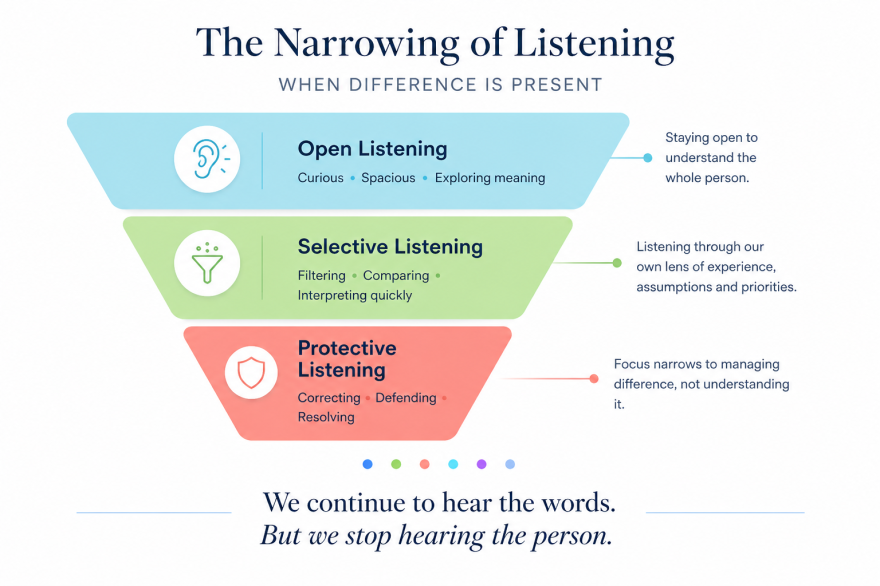
In tense situations, listening can become subtly narrower. Not intentionally, but almost imperceptibly.
Attention tightens. Patience shortens. Certainty increases. We continue to hear the words being spoken, but we are no longer listening in the same way. The focus moves from understanding to interpretation, from curiosity to evaluation.
And over time, we stop hearing the person behind what is being said.
The Leadership Reality
In pharmacy, leadership and healthcare, difference is not occasional. It is built into the system.
It exists across professional roles, levels of responsibility, generational perspectives, and differing values and priorities. It also exists within structures of power, where some voices carry more weight than others, and where not everything that matters is always spoken openly.
These dynamics shape not only what is said, but what remains unspoken, and how safely it can be expressed.
What We Stop Hearing
In my work with leaders, I often notice that when someone does not see the world as we do, our listening shifts.
We listen more closely for what needs to be corrected, clarified, or resolved. We move more quickly towards sense-making and decision-making. Less often do we remain with what is unfamiliar or uncomfortable long enough to fully understand it.
In doing so, we can miss what is meaningful to the other person, what risk they are naming, or what they are trying to protect. Decisions are then shaped before all perspectives are fully understood.
This is rarely a conscious choice. It is a protective response. But it is also the point at which listening becomes selective.
Listening Beyond Agreement
Listening across difference is not about reaching agreement. It is about remaining present long enough to understand what sits beneath a perspective, even when it does not align with our own.
This does not require us to adopt another position. It asks something more restrained and, at times, more demanding. It asks us to recognise what informs that perspective, what matters within it, and what might otherwise go unnoticed.
This kind of listening requires discipline. Not in the sense of effort or control, but in the sense of restraint. The restraint not to move too quickly, and not to resolve too early.
Where Power Sits in the Room
Power is always present in these moments.
It exists in role, in experience, and in confidence. It influences who feels able to speak openly, who holds back, and how messages are shaped before they are spoken.
Listening across difference includes an awareness of these dynamics. Not as something to fix, but as something to remain conscious of. Without that awareness, it becomes easier to assume that silence means agreement, or that what is said reflects everything that is present.
A Point to Pause
If you recognise any of this in your own leadership, it may be worth pausing with it.
Not to change your position or arrive at a different answer, but to notice the quality of your listening. Where does it narrow? What do you move away from quickly? What becomes harder to stay with?
A Question Worth Holding
What do I stop hearing when someone does not see the world as I do? And what is the (unintended) impact on our leadership, patient-care & relationships?
If This Reflection Is Pointing Somewhere
For some, this reflection is enough.
For others, it may be pointing to conversations that are more complex than they first appear.
If you are navigating difference and want to avoid collapsing into control or avoidance, a 90-minute Strategic Thinking Session offers a focused, confidential space to think clearly about what is present and how you want to lead within it.
You can schedule a session here: 90-minute Strategic Thinking Session
For those who want to develop this more consistently over time, particularly in relation to leadership, coaching, and working across difference in complex systems, the Lead With Coaching Institute offers a structured and relational space to deepen this work.
You can learn more about the next cohort here: Lead With Coaching Institute
Closing Reflection
Leadership does not become more effective by hearing more.
It becomes more effective by noticing what we stop hearing.
|