|
What Are You Still Carrying?
Leadership capacity, shared responsibility and knowing what is truly yours to hold
Having carried a few bags this summer, earlier this month, I found myself reflecting on a question that has stayed with me:
What no longer needs to be carried?
It is a simple question, but perhaps not an easy one.
Leadership naturally brings responsibility. In pharmacy and healthcare, that responsibility is very real. There are patients to protect, professional standards to uphold, teams to support and decisions that cannot simply be passed elsewhere.
Yet responsibility and carrying everything are not the same thing.
Over time, capable leaders can become accustomed to holding more than the role genuinely requires of them. Not because they do not trust others. Often, quite the opposite. They care deeply about the quality of the work and the people affected by it.
They know they can make the decision quickly. They can answer the question. They can step in when something is unclear. They can make sure it gets done.
And so they do.
Again and again.
Until something that began as responsible leadership quietly becomes the way the organisation operates.
When Everything Begins to Flow Through the Leader
In my work with leaders, I often notice that this rarely happens through one significant decision.
It happens gradually.
A colleague asks for approval because that has become the habit. A decision comes back to the leader because no one is quite sure where authority sits. A team member raises a problem but leaves the thinking with someone else. A responsibility that was meant to be temporary somehow remains with the same person several years later.
None of these things necessarily looks concerning on its own.
Taken together, however, they can create an organisation where too much depends on one person's attention, judgement or availability.
The leader may still be managing.
The organisation may still be performing.
But leadership capacity is being consumed in places where it may no longer create the greatest value.
This is where I think an important distinction becomes useful.
Being responsible does not mean being responsible for doing everything yourself.
What Is Truly Yours to Hold?
Some responsibilities belong with the leader.
Professional accountability matters. Patient safety matters. Ethical judgement matters. There are decisions where experience, authority and professional responsibility cannot simply be handed over.
But there are other things we continue to carry because we have always carried them.
Perhaps we know the task well.
Perhaps explaining it feels more difficult than doing it ourselves.
Perhaps someone once made a mistake and we quietly took the responsibility back.
Perhaps the organisation grew, but the way decisions are made did not grow with it.
Or perhaps we have simply never stopped long enough to ask whether something still belongs with us.
That is where discernment becomes important.
The question is not:
How do I get more off my plate?
It is:
What genuinely requires my leadership now?
Those are very different questions.
The first is about reducing workload.
The second is about using leadership capacity wisely.
Support Is Not the Same as Dependency
There is another distinction I find myself thinking about.
Supporting people is an important part of leadership. So is coaching, mentoring, guiding and creating the conditions in which others can grow.
But support can gradually become dependency when the leader becomes the place where thinking repeatedly stops.
Someone brings a challenge and waits for the answer.
Someone brings a decision and asks for approval before forming their own judgement.
Someone knows they have responsibility but remains hesitant to use the authority that comes with it.
In those moments, stepping in may be quicker.
But quick is not always the same as useful.
Sometimes the more valuable leadership response is to remain curious for a little longer.
What do you think?
What have you considered?
What decision would you make if I were not available?
What support do you actually need from me?
These questions do not remove responsibility from the leader.
They create space for responsibility to develop elsewhere too.
Trust Requires Clarity
Sharing responsibility is not the same as stepping away from it.
Particularly in pharmacy and regulated healthcare environments, delegation needs judgement. Roles, boundaries and expectations matter. People need to understand what has been entrusted to them, where their authority begins and ends, and when something needs to come back to a more senior level.
Trust without clarity can create uncertainty.
Clarity without trust can create control.
Healthy leadership needs both.
This may mean being clearer about who owns a decision. It may mean agreeing what good judgement looks like rather than prescribing every step. It may mean allowing someone to approach the work differently from the way you would have done it yourself.
And sometimes it means remaining available without remaining involved in every detail.
There is maturity in knowing when your presence adds value.
There is also maturity in recognising when your continued involvement may be preventing someone else from developing theirs.
Leadership Capacity Is a Resource
Earlier this month, I wrote about Return on Leadership Capacity.
The idea continues to stay with me because leadership capacity is finite.
Attention is finite.
Decision-making energy is finite.
The ability to remain thoughtful, curious and steady under pressure is affected by what we are already carrying.
This does not mean leadership should feel easy.
It does mean we may need to become more deliberate about where our capacity is being used.
When a leader's attention is absorbed by decisions that could appropriately sit elsewhere, there is less space for the work only they can do.
The difficult conversation.
The longer-term question.
The relationship that needs attention.
The emerging risk.
The opportunity that requires thought rather than speed.
The space to notice what the organisation may be quietly telling them.
Leadership capacity is not simply about having more time.
It is about protecting enough space to lead.
A Leadership Capacity Pause
You might find it useful to take a few minutes this week and look at what you are currently carrying.
Ask yourself:
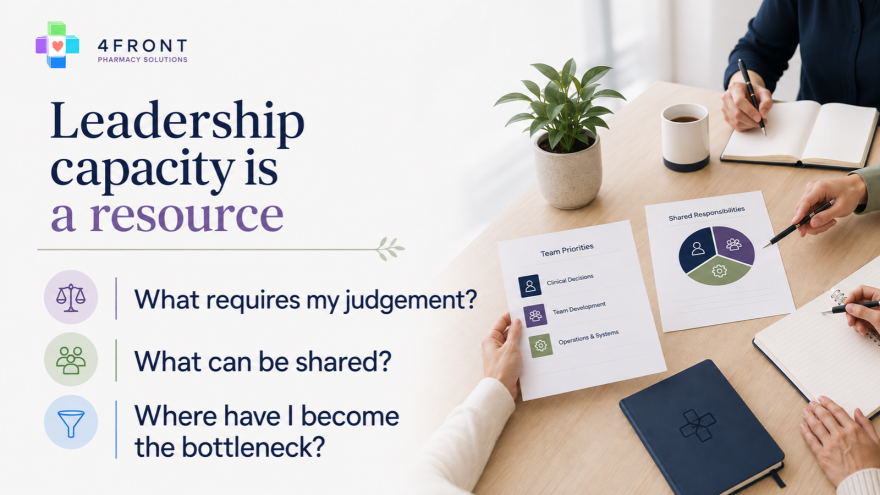
What genuinely requires my judgement, authority or experience?
What am I still holding because I have always held it?
Where does my team seek permission when what they may really need is confidence and clarity?
What responsibility could help someone else grow if I allowed them to carry more of it?
Where have I unintentionally become the point through which too much must pass?
And perhaps most importantly:
If I stopped carrying one thing that no longer needs to sit with me, what space might that create for the leadership that does?
There may not be an immediate answer.
That is all right.
Sometimes the value of a good leadership question is that it stays with us long enough for a more honest answer to emerge.
Listening to Pharmacy Leadership
These questions about responsibility, capacity and what feels heavier than it needs to are also part of what I hope to understand more deeply through the Leadership Listening Project.
Rather than making assumptions about what pharmacy leaders need, I want to hear from the people living the work.
If you are a pharmacist or pharmacy leader and have not yet contributed, your experience matters. The Listening to Pharmacy Leadership Survey takes less than 10 minutes, and what you share will help shape future leadership conversations and resources grounded in the realities of pharmacy practice.
Add your voice: https://forms.gle/73LxF2ugLNtttvECA
Your responses will be treated respectfully and confidentially.
A Question to Leave With You
There will always be things that leadership asks us to carry.
Responsibility is part of the role.
But perhaps mature leadership is not measured by how much we can continue to hold.
Perhaps part of leadership is knowing what is ours to carry, what is ours to share and what we now need to trust others to hold.
So I will leave you with the question that started this reflection:
What are you still carrying that no longer needs to sit with you?
Warm regards,
Rachel Dungan
The Pharmacist Coach
MPSI | ICF-MCC | ACTC | NBC-HWC | EMCC-SP
Director of Education, Lead With Coaching Institute
Founder, 4Front Pharmacy Solutions
P.S. If this newsletter has highlighted something important you would like space to think through, reply to me at rachel@racheldungan.com and tell me what you are carrying. I will point you towards the most appropriate next step, whether that is a Strategic Thinking Session, 1:1 Coaching, the LCI Certificate, or simply a useful resource.
|