|
Part 2 of 3
What Change Asks of the People Implementing It
Why communicating change is not the same as helping people implement it

Over the summer, I spent a considerable amount of time in the weeds of credentialling, accreditation and changing professional standards.
I renewed my ICF and EMCC credentials, completed further specialisations in mentor coaching and coaching supervision, and began considering what emerging requirements may mean for the programmes we deliver through Lead With Coaching Institute.
By the end, my professional signature was beginning to resemble what I sometimes call a “letter salad”.
Behind each letter, however, was something more significant: hours of reading, interpreting, gathering evidence, reflecting and making decisions.
I am familiar with these professional systems. I work within them and support other people as they navigate them. Even so, there were many moments when I had to slow down, reread the guidance and work out what a particular change really meant in practice.
It brought something important into focus.
A change that appears straightforward at an institutional or organisational level can feel very different to the person expected to implement it.
Following the Ripple
This is Part 2 of our series, Listening to Impact: The Ripples We Create.
In Part 1 of our series, The Impact We Cannot Always See, we considered how power, presence and the quality of our listening can help people participate more fully or cause them to withdraw and protect themselves.
The central question remains:
What impact am I actually having, not just intending?
When we lead change, our intention may be improvement, consistency, accountability or professional development.
The actual impact depends on how the change reaches the people responsible for implementing it.
A decision may begin in a professional body, boardroom or leadership meeting. It then travels through organisations, teams and individual practitioners.
Eventually, it reaches the person who must interpret it, explain it to a colleague, incorporate it into an already demanding working day or provide evidence that it has been completed.
Each stage creates another ripple.
Standards, governance and professional accountability matter. They help protect the people and communities we serve. A sound decision can still create unintended consequences if we do not listen to the people closest to the work.
The question is not only, “Have we communicated the change?”
It is also, “Have we understood what this change will ask of people?”
When an Expert Becomes a Beginner Again
A pharmacist may be highly experienced in clinical practice and still feel uncertain when faced with a new professional process.
A capable coach may have years of experience and still need time to interpret revised credentialling requirements.
A senior leader may understand an organisation deeply while feeling less certain about how to guide people through a particular transition.
Expertise in one area does not make every new system immediately clear.
Yet capable professionals often believe they should already know what to do. They sit with the guidance, reread the same paragraph and begin to second-guess their interpretation.
What might have been manageable with a little clarity becomes another source of mental load.
This is where power can appear in subtle ways.
When a process is designed or communicated by people who already understand it, they may underestimate what it is like to encounter that process for the first time.
Language that feels precise to the expert may feel inaccessible to the practitioner. A simple administrative step may sit within a much more complicated working reality.
If we are not listening carefully, we may mistake uncertainty for resistance. We may interpret a request for clarity as an unwillingness to take responsibility.
Listening changes that interpretation.
It allows us to recognise that someone may support the purpose of the change while still needing time, practice or guidance to implement it well.
Life Happens
Even the clearest professional process meets the unpredictability of real life.
People become unwell. Families need attention. Teams experience staffing pressures. Workloads change. Technology does not behave as expected.
What looked achievable several months ago can feel very different as a deadline approaches.
“Life happens” is not an argument against accountability. It is a reminder that accountability works best when it is accompanied by clarity, proportion and appropriate support.
As leaders, we cannot remove every difficulty. We can pay attention to how change is being experienced.
We can invite questions before uncertainty becomes silence. We can clarify what is essential. We can create opportunities for people to practise before they are expected to perform under pressure.
That is part of working with people as members of a living system rather than treating implementation as a transaction.
The Invisible Consequences of Poorly Supported Change
The impact of change is not always immediately visible.
A person may appear to comply while becoming less confident.
A team may meet the deadline while becoming increasingly dependent on one leader.
A new process may be introduced successfully while responsibility quietly moves upwards because no one else feels able to make a decision.
These consequences matter because they affect more than the implementation itself. They influence trust, ownership, participation and future capacity.
A change intended to strengthen accountability may inadvertently weaken it.
A decision intended to create consistency may prevent people from speaking about what does not fit their context.
A process intended to improve professional practice may become another task to complete rather than an opportunity to learn.
Recognising these consequences does not mean the change was wrong. It means implementation deserves as much attention as intention.
What I’m Hearing
In conversations with leaders and professionals, I am hearing that most people are not opposed to development or higher standards.
They want to do good work. They want to maintain professional integrity and contribute well.
What they often need is enough space to contribute to & understand what is changing, what remains within their responsibility and what good implementation will look like in practice.
They need to be able to ask a question without feeling they should already know the answer.
They need opportunities to practise a different kind of conversation before trying to lead it when responsibility and pressure are real.
Without that space, people may become quieter, more cautious or increasingly dependent on whoever appears to hold the answers.
Responsibility begins to flow upwards, even when the intention was to strengthen ownership throughout the organisation.
A coaching approach offers another possibility.
From Announcing Change to Leading It
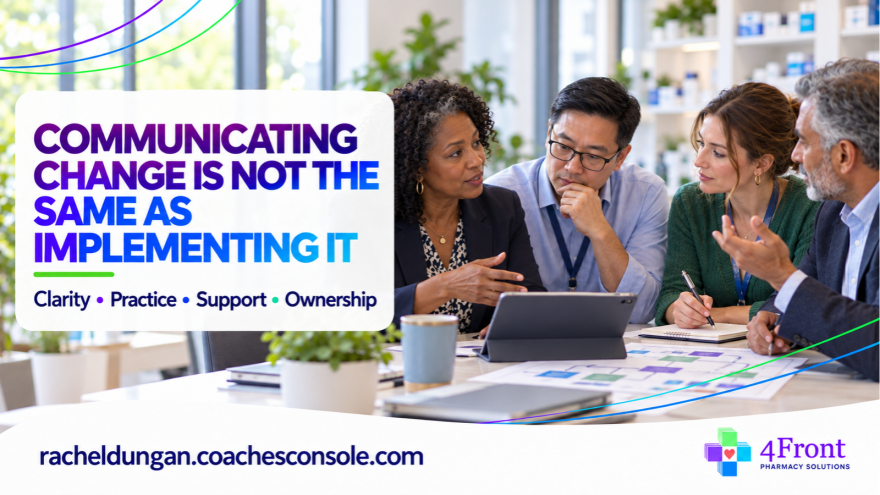
Leadership during change is not simply about providing information. It is about helping people make meaning, think clearly and take appropriate responsibility.
Instead of asking only, “Have you completed this?”, we might also ask:
-
What is clear, and what still needs to be understood?
-
What impact is this change having on your work?
-
What assumptions are we making about people’s capacity or confidence?
-
Where is responsibility appropriately held?
-
Where has responsibility become unclear?
-
What support would help people move forward without removing their ownership?
-
What can we learn from those closest to the work?
These questions do not weaken accountability. They make accountable action more possible.
They help us move away from power over or power under and towards power with.
That does not remove the leader’s authority. It improves how authority is used.

What Becomes Possible When Leaders Practise Differently?
Lead With Coaching Institute (LCI) was created to help leaders develop this kind of practice.
The purpose is not simply to add another communication technique to a leadership toolkit. It is to strengthen the quality of thinking, listening and shared responsibility within teams.
Participants learn and practise how to listen beyond the first answer, ask questions that support clearer thinking and recognise when coaching is appropriate and when another leadership response is required.
They also consider how to work more consciously with power, support ownership without stepping away from accountability and create conversations in which people can think together under pressure.
The wider impact can reach beyond the original conversation.
When one leader listens differently, another person may think more clearly. When a team becomes more able to speak openly, decisions improve. When responsibility is shared appropriately, leaders recover capacity previously consumed by carrying too much.
Participants sometimes notice the same skills appearing in unexpected places: in family conversations, community work or the way they listen to a teenager who does not need an immediate solution.
That is the nature of a ripple. We cannot always know in advance where it will travel.
Our next Lead With Coaching programme begins in February.
If you or your team are preparing for change, strengthening leadership capability or seeking to create a more thoughtful culture of responsibility, you can explore the available pathways here:
Explore Lead With Coaching programmes
You are also welcome to reply and tell me what you hope might become possible as a result. A conversation can help you decide whether the programme is the right fit for you or your organisation.
If You Need Space for Your Own Decision
Sometimes the first step is not a team/group programme. It is creating enough space to think clearly about a question of your own.
You may be interpreting a professional change, considering a leadership decision or trying to support others without absorbing every responsibility yourself.
My 90-minute Strategic Thinking Session offers a confidential space to step back from immediate pressure, examine what is happening and decide what a thoughtful next step might be.
It is not a session in which I tell you what to do. It is a partnership designed to help you hear your own thinking more clearly, notice what may have been overlooked and make a decision aligned with your responsibilities, values and capacity.
One Question for You
What change are you asking people to carry, and what support have you made available to help them carry it well?
Reply with a sentence if you would like to share your reflection. I read every response.
If you missed Part 1, you can read The Impact We Cannot Always See in the newsletter archive.
Coming Next
Understanding the impact of change is important. Eventually, awareness must become preparation.
In the final part of this series, we will consider what unfinished professional responsibility may already be consuming energy you will need in 2027.
Part 3, What Are You Carrying Into 2027?, will arrive on Wednesday, 28 October.
If someone in your circle is leading or experiencing significant change, please forward this newsletter to them. They can subscribe to receive future newsletters here.
Warm regards,
Rachel Dungan
The Pharmacist Coach
MPSI | ICF-MCC | ACTC & ITCA | NBC-HWC | EMCC-SP & ESIA | ICF-MCS & CSS
Director of Education, Lead With Coaching Institute
Founder, 4Front Pharmacy Solutions
P.S. If this newsletter has highlighted something important you would like space to think through, reply to me at rachel@racheldungan.com and tell me what you are carrying. I will point you towards the most appropriate next step, whether that is a Strategic Thinking Session, 1:1 Coaching, the LCI Certificate, or simply a useful resource.
|